Funded under the National Recovery and Resilience Plan (NRRP), Mission 4 Component 2 Investment 1.3, Theme 10.



FeaturesSpoke 01
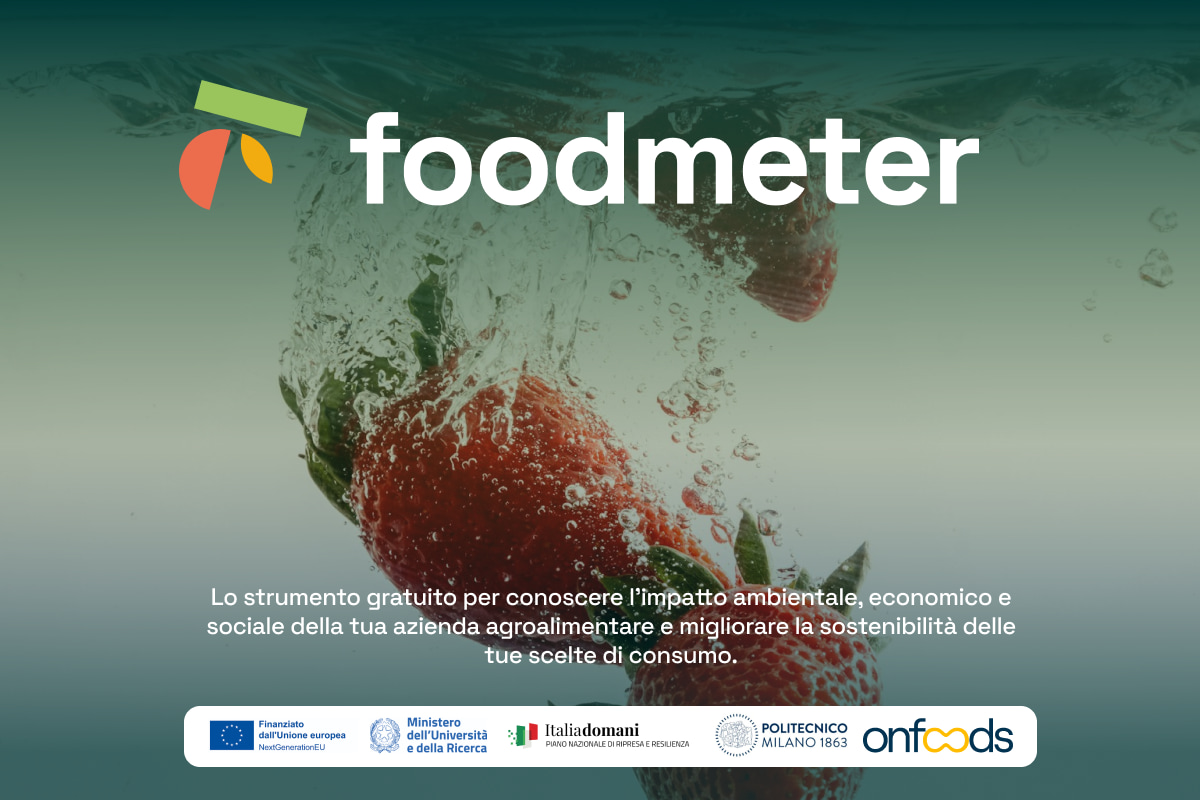
Foodmeter: the new free tool for measuring the sustainability of agri-food supply chains
A digital tool developed within OnFoods supports agri-food SMEs in assessing and improving sustainability across fruit and vegetable supply chains, translating research into actionable metrics.

Giulio Burroni
Communication manager
Published: April 13, 2026
Share:
In recent years, sustainability has become a priority for businesses and institutions, driven by an increasingly stringent regulatory environment. The introduction of the European Union’s Corporate Sustainability Reporting Directive (CSRD), for example, requires large companies to measure and report their environmental, social, and economic impact. Although not directly mandated, many small and medium-sized enterprises (SMEs) are indirectly affected by these regulations, especially when they operate as suppliers in monitored supply chains.
At the same time, expectations around environmental and social performance are increasing across agri-food systems, extending beyond compliance to include transparency, resource efficiency, and responsible practices along the entire production chain.
Agricultural businesses, for their part, face a series of complex and interconnected challenges. On the one hand, they must comply with increasingly stringent regulations and quality standards; on the other, they are called upon to innovate their processes to reduce their ecological footprint, improve efficiency, and ensure sustainable competitiveness.
This scenario represents not only a test but also an opportunity to redefine production models and align more closely with the expectations of the global market. It is a true transition in mindset and practice that, however, cannot occur without scientific research providing solid definitions and the implementation of effective metrics and measurements for sustainability.
In this context, the adoption of multicriteria decision analysis (MCDA) methods is considered one of the most suitable and promising approaches to fully capture the complex and large-scale effects of agricultural practices and agri-food supply chains.
Once the most effective methods and criteria are identified, it is important to bring research closer to the operational level, and for this purpose, technology can become the bridge between two worlds that are often too distant.
It is within this framework that Foodmeter fits: a digital application designed to support agri-food businesses in assessing and improving the sustainability of their production processes.
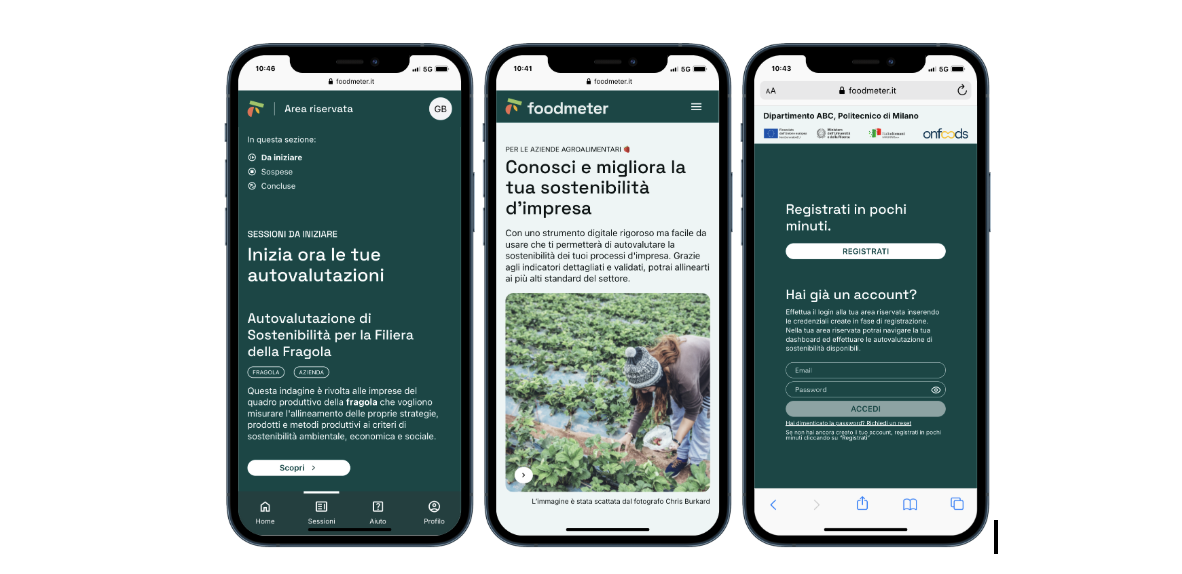
A platform born from the research of the Politecnico di Milano within the OnFoods project.
Foodmeter is one of the tangible outcomes of the PER-REP project, coordinated by the ABC Department of the Politecnico di Milano and part of Spoke 1 (Global Sustainability) of OnFoods, a research partnership funded by the PNRR.
The application is designed to offer a free, practical self-assessment tool based on scientifically validated indicators. Its main objective is to enable small and medium-sized enterprises to measure the sustainability of their processes and identify areas for improvement.
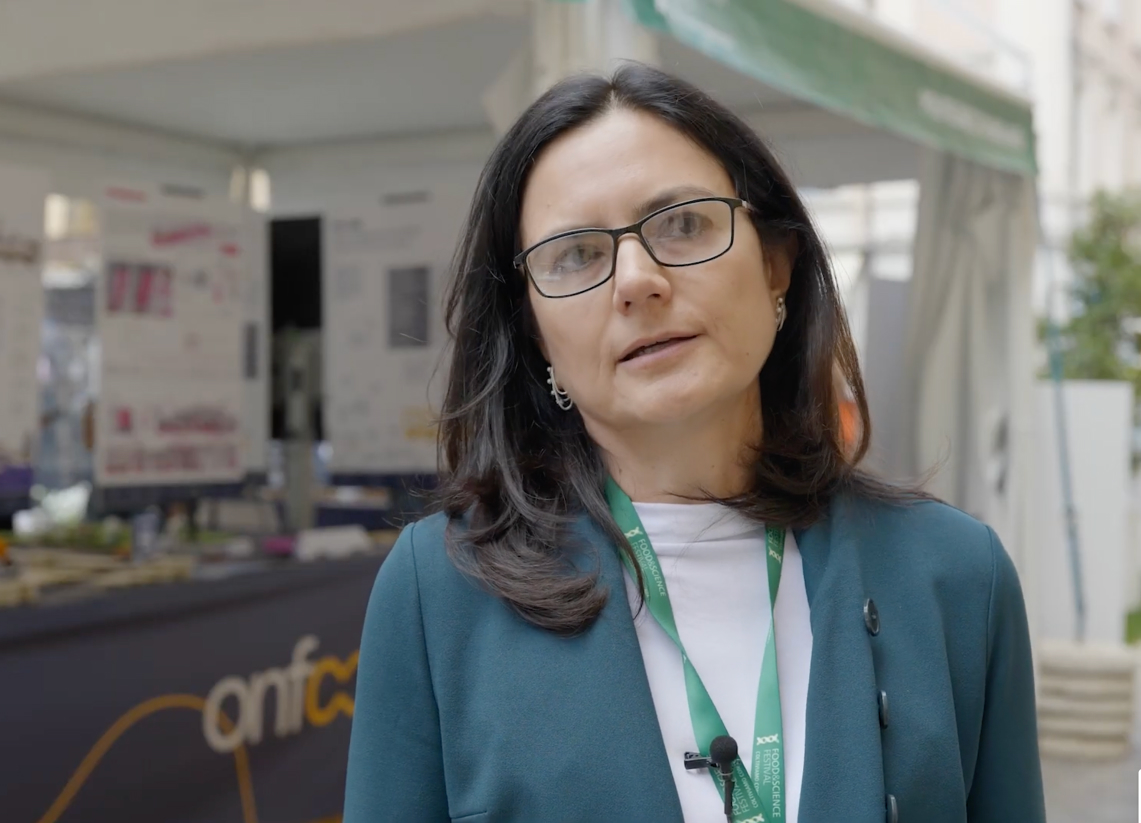
The overall vision that guided the project,” comments the principal investigator of PER-REP, Prof. Paola Caputo, “is to promote awareness and the spread of tools to foster greater sustainability, concretely facilitating the improvement of the environmental and social impact of one’s activities.
How does Foodmeter work?
The application, easily accessible via web browser on all common desktop and mobile devices, is divided into two main areas: a public section that introduces the service and the context of sustainability, and a reserved area where registered users can complete self-assessments, access the results, and download their sustainability badges.
The indicators used by the research group to define the self-assessment cover several macro-areas, including environmental parameters (such as energy consumption, water use, and waste management), social parameters (such as labor practices), and economic ones.
Once the self-assessment is completed, the user receives a detailed report with specific recommendations to improve critical areas.
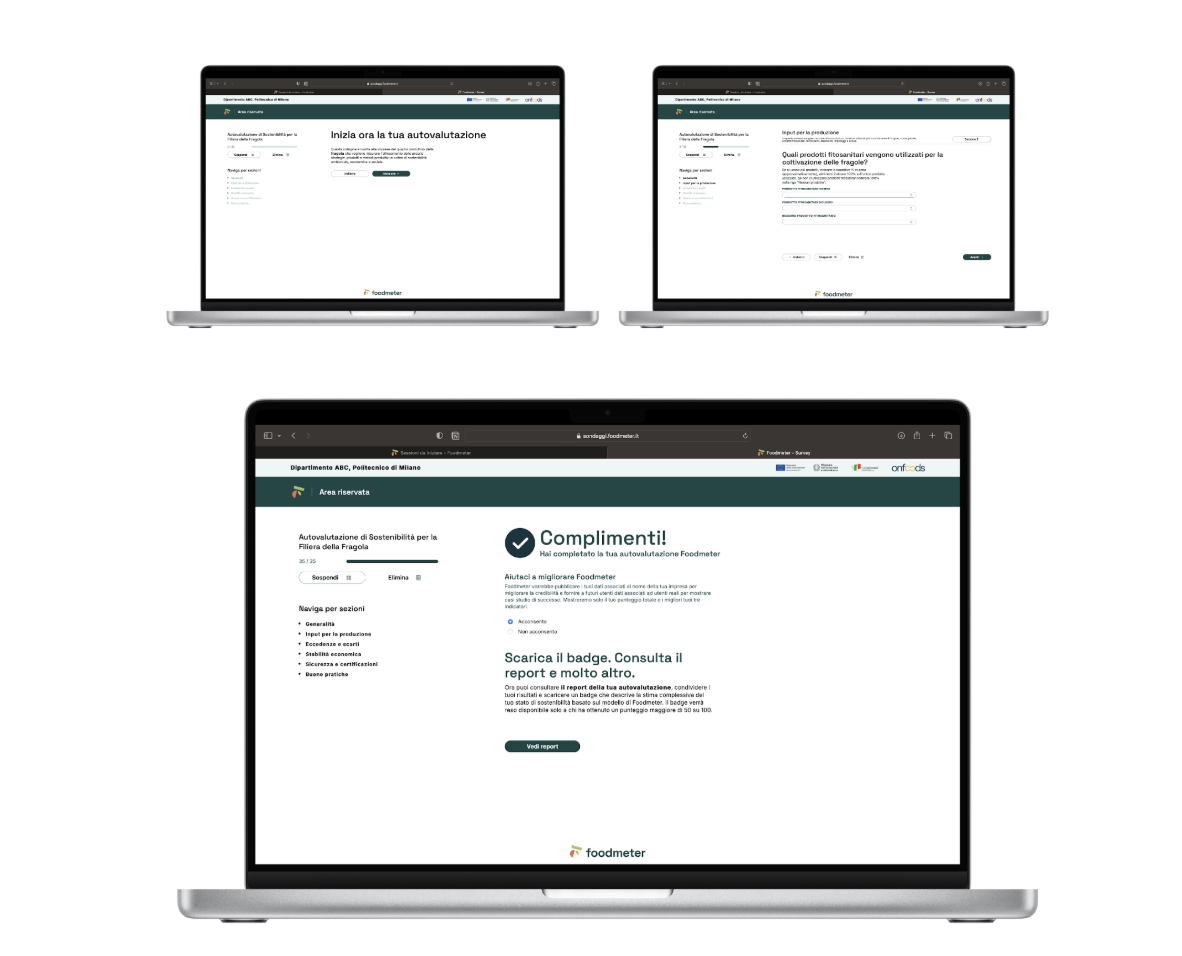
Originally developed with a focus on a specific supply chain, the application has now been extended to cover the broader range of fruit and vegetable supply chains, increasing its applicability and relevance across the agri-food sector.
The intention to develop this application,” continues Paola Caputo, “stems from a fundamental awareness: scientific research represents an invaluable social and innovative resource that, however, risks suffering from a gap with practical implementation. For this reason, it seemed important to us to integrate the results of our research into a tool that can be used by the main actors of the agri-food system: businesses.
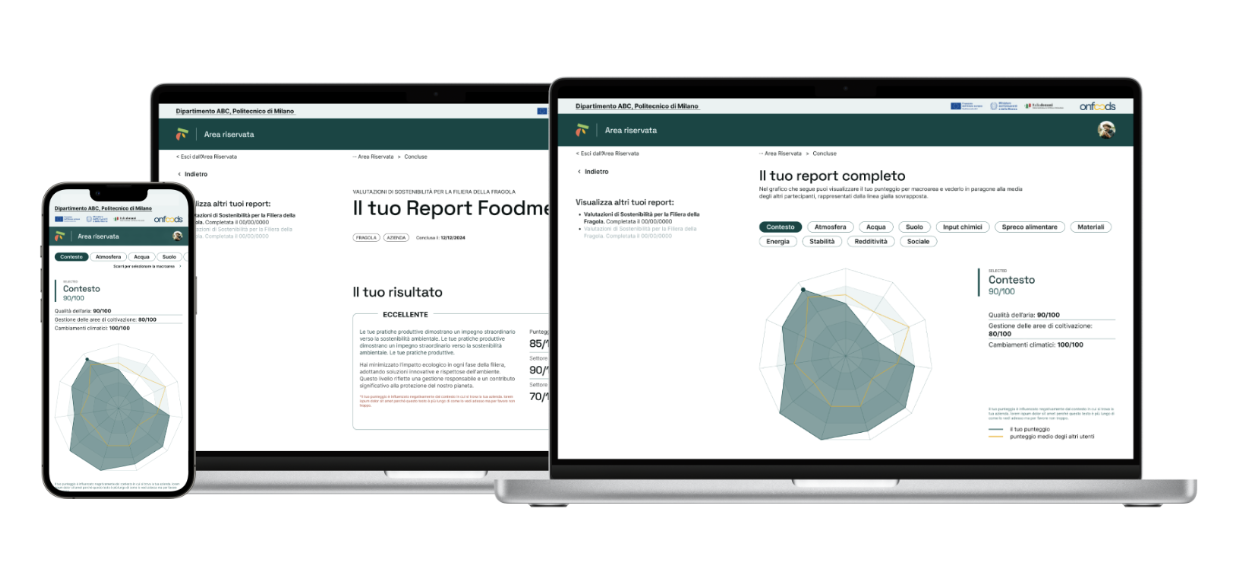
In a context where sustainability is no longer an option but a necessity, Foodmeter is an example of how academic research can be translated into useful tools for the productive world. Small and medium-sized enterprises (SMEs), often lacking the resources to independently manage sustainability monitoring, find in platforms like this a concrete support to navigate the complexities of new scenarios.
The next step for Foodmeter will be its official launch and the further consolidation of its features to support an increasing number of businesses across agri-food supply chains in the transition toward greater sustainability.
The working group of the PER-REP research project (Decision-making tool for sustainability performance assessment, communication, and reporting)
Foodmeter was developed as part of the activities of the PER-REP research project, which falls under Spoke 1 of OnFoods. Below are the people who worked on the project:
Paola Caputo is an Associate Professor at the Politecnico di Milano (DABC) in the field of Environmental Technical Physics. She holds a degree in Environmental Engineering and a PhD in Energy, and her research focuses on energy systems, renewable district heating networks, and energy-environmental analysis of agri-food supply chains. She collaborates with universities and international working groups and has numerous scientific publications to her name.
Giulio Ferla is a Researcher at the Politecnico di Milano in the field of Environmental Technical Physics. He graduated in Civil Engineering in 2018 and obtained his PhD in 2021 from the DABC of Politecnico di Milano, focusing on the analysis and optimization of biomass district heating systems. His work covers buildings, energy, and renewable sources, with expertise in district heating systems, energy communities, energy modeling, and energy-environmental assessments of agri-food supply chains.
Silvia Falasco is a Research Fellow at the Politecnico di Milano, where she focuses on sustainability assessments of agri-food supply chains. She graduated in Food Innovation and Management in 2021 from the University of Gastronomic Sciences and is currently completing her PhD at the DABC of Politecnico di Milano, with a focus on the environmental assessment of food production, distribution, and consumption.
Benedetta Mura, who graduated with honors in Building Engineering-Architecture from the Politecnico di Milano, after conducting a research project on the energy-environmental assessments of agri-food supply chains, is currently a PhD student at the same institution, focusing on innovative thermal networks powered by renewable sources and waste heat.
The Foodmeter application was developed by Dinamo, a development and communication company, which handled the branding, content, interface design, backend development, and integrations with the calculation methods defined by the PER-REP team.
Giulio Burroni
Communication manager
Specialist in Communication and Project Management with over 8 years of experience in agency work. Currently involved in communication, branding, and design projects within the public administration, research institutions, and university sectors
This blog post is related to
Global sustainability
Fair food markets for healthy citizens
Lead organisation
Spoke leaderFilippo Arfini
Research projectPER_REP
Decision-making tool for sustainability performance assessment communication and reporting
Principal investigators
Paola Caputo
Referred to
Spoke 01